Flotation is an important step in SUPREEMO’s approach to recovering rare earth elements (REEs) from primary deposits. Its purpose is to separate the valuable REE-bearing minerals from the material surrounding them and produce a richer concentrate for the next processing steps. By doing this early in the process, less material needs to be treated downstream, helping to reduce reagent consumption, energy demand and overall processing costs.
But a flotation process that works well in the laboratory does not automatically behave in the same way when it is scaled up. Once larger quantities of material are processed continuously, factors such as froth stability, reagent distribution, pulp density, particle size, residence time and equipment configuration become increasingly important. This is why pilot testing is such a critical step. It allows the project to see whether the process remains stable, controllable and reproducible under conditions that are much closer to future industrial operation.
Within SUPREEMO, SINTEF is developing and optimising the flotation process at laboratory scale, while TUKE is responsible for taking this process to pilot scale. The pilot campaign, operated by TUKE, will take place at DIAMO’s facilities, where the necessary infrastructure and permitting framework are available for working with materials that may contain naturally occurring radioactive elements.
REE deposits can contain elements such as uranium and thorium, although their presence and concentration vary considerably from one deposit to another. This means that the materials need to be properly characterised and handled throughout preparation, flotation, concentrate production and residue management.
Scaling up the flotation process is therefore not only about processing more material. It is also about showing that the process can be operated safely and reliably under realistic conditions.
Why carry out the pilot campaign at DIAMO?
DIAMO was selected for this role because of its extensive experience in the management and treatment of materials associated with radiological and environmental considerations. Its facilities combine industrial infrastructure with established procedures for material handling, environmental protection, monitoring and waste management. Importantly, the organization holds accreditation according to ČSN EN ISO/IEC 17025:2018 at its uranium mining and processing facility for work involving radioactive materials.
This provides SUPREEMO with the infrastructure and operational framework needed to investigate pilot-scale flotation performance while also addressing the practical requirements that would need to be considered in future industrial deployment.
Preparing for the Upcoming Pilot Operations
While SINTEF continues to optimise the flotation process at laboratory scale, TUKE is preparing to bring these results into pilot operation. This means defining the conditions to be tested, the amount of material required, the sequence of the trials and the analytical work needed to assess performance. In parallel, DIAMO is preparing the facility, infrastructure and procedures required to safely manage the material throughout the campaign, from the incoming feed to concentrates, tailings, process water and other residues.
The pilot flotation campaign will be an important milestone for SUPREEMO, as it will show whether the process developed at laboratory scale can maintain its REE recovery and selectivity when operated at a larger scale, while also helping to identify any adjustments needed before further scale-up.
The concentrate produced during the campaign will also provide the feedstock for the next part of SUPREEMO’s processing chain. DIAMO will subsequently lead the work on the hydrometallurgical extraction of REEs from this concentrate, creating a direct link between mineral concentration and downstream REE recovery.
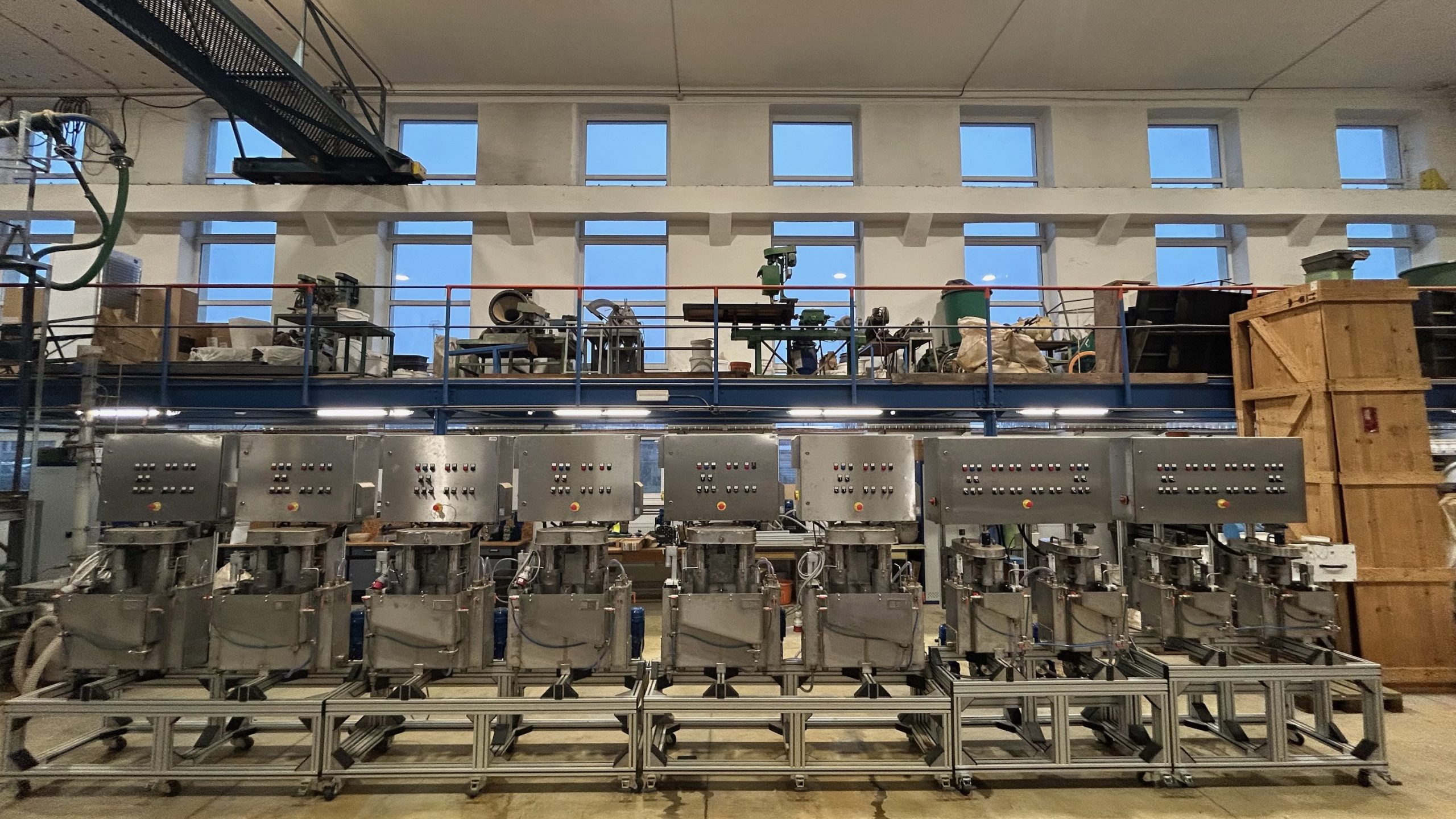
Photos and visuals: the pilot plant built by TUKE.